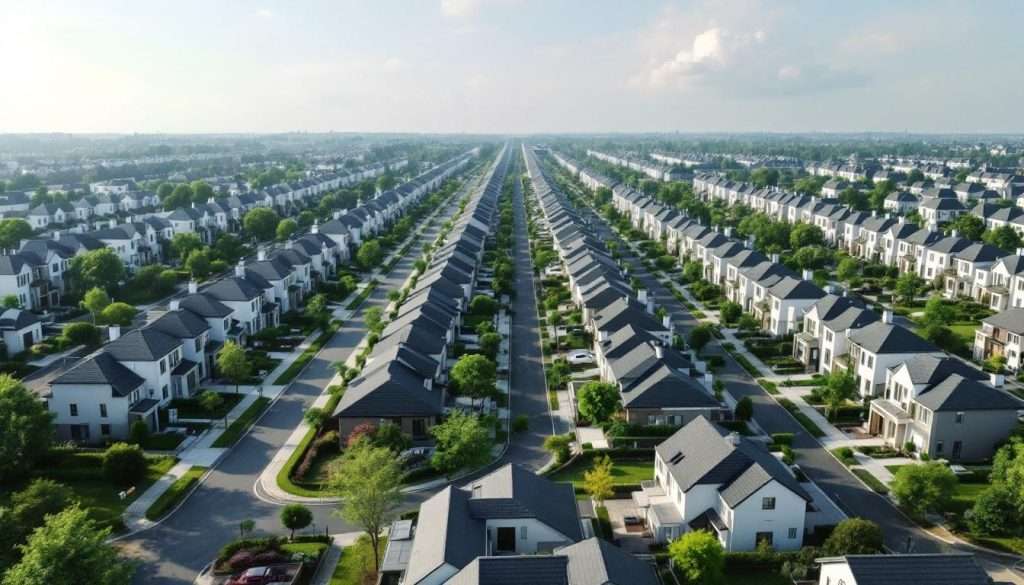
Single-family rental housing has transitioned from a fragmented cottage industry of individual landlords to one of the fastest-growing institutional real estate sectors in the country. Build-to-rent (BTR) — purpose-built single-family homes designed from the ground up as rental properties rather than for-sale housing — has emerged as the dominant development strategy for institutional capital entering the single-family space.
This is not a temporary arbitrage or a speculative bet. The capital flowing into build-to-rent reflects a structural thesis about American housing demand, household formation trends, and the growing preference for single-family living among renters who either cannot or choose not to purchase. For accredited investors evaluating real estate allocation, understanding the BTR thesis, its economics, and its risks provides insight into a sector that is reshaping how institutional portfolios approach residential exposure.
Why Build-to-Rent Exists as a Strategy
The traditional path to single-family rental investing was acquisition: buy an existing home, renovate if necessary, and rent it. This approach works at small scale but becomes operationally difficult at institutional scale. Existing homes are heterogeneous — different floor plans, different ages, different systems, different maintenance profiles. Managing 500 individually acquired homes spread across a metro area requires managing 500 different maintenance profiles, which creates operational drag that erodes returns.
Build-to-rent eliminates this problem by designing a community of homes from the ground up with rental operation in mind. Every home in a BTR community has the same systems, the same finishes, the same floor plan (or a small number of standardized plans), and the same maintenance requirements. This standardization enables institutional-quality property management at scale — the same approach that makes 300-unit apartment complexes operationally efficient applied to single-family housing.
BTR communities also offer amenities that individual rental homes cannot: shared pools, fitness centers, parks, walking trails, and community spaces. These amenities allow BTR operators to command rent premiums above comparable individual rental homes while creating a community environment that reduces turnover and increases tenant retention.
The Demand Thesis Behind Institutional BTR
The capital thesis for BTR rests on several converging demand drivers:
Homeownership affordability has structurally declined. Median home prices relative to median household income in major metro areas have reached levels that exclude a growing share of households from ownership. In Southern California, the median home price exceeds 8x median household income in many submarkets. This ratio has historically been 3 to 4x in balanced markets. The result is a growing population of households that earn enough to afford quality single-family housing as renters but cannot access ownership.
Household formation among millennials and Gen Z favors single-family rentals. Adults aged 28 to 42 — the prime household formation demographic — are forming families and need space that apartments cannot provide (yards, storage, privacy, garages) but face affordability and credit barriers to purchasing. These households are the primary demand driver for BTR: they want single-family living, can afford market rents, and are renting by constraint or by choice.
The for-sale housing market is undersupplied. National housing production has lagged household formation since 2008. The cumulative undersupply — estimated at 3 to 5 million homes nationally — creates sustained demand pressure that supports both ownership and rental pricing. BTR adds supply specifically designed for the rental segment, capturing demand that for-sale builders cannot serve at current pricing levels.
Lifestyle renters are a growing segment. A meaningful and growing share of high-income renters choose to rent despite having the financial capacity to purchase. These households value flexibility, the absence of maintenance responsibility, and the ability to relocate without selling a home. BTR communities designed for this demographic command premium rents and experience lower turnover because the renters are there by choice rather than by financial constraint.
The Economics of BTR Development
BTR development economics differ from for-sale homebuilding in several important ways:
Development costs for BTR are typically 10 to 20 percent lower per unit than comparable for-sale homes because BTR homes are designed for durability and maintenance efficiency rather than sale appeal. Commercial-grade finishes, standardized systems, and designs that minimize long-term maintenance costs (concrete driveways rather than asphalt, commercial-grade HVAC rather than residential-grade) cost marginally more upfront but reduce operating costs over a 15 to 20-year hold period.
Revenue begins immediately upon lease-up rather than requiring each unit to be sold individually. A 200-home BTR community that leases at 15 to 20 homes per month reaches stabilization in 10 to 14 months, generating income throughout the lease-up period. A for-sale community of the same size must sell each home individually, with revenue arriving one transaction at a time over 18 to 36 months.
Exit optionality is broader for BTR. A stabilized BTR community can be sold to another institutional investor as a performing asset, refinanced to return investor capital while maintaining ownership, or (in some cases) converted to for-sale housing if market conditions favor disposition. This optionality provides sponsors with multiple paths to investor returns depending on market conditions at the time of exit.
Risks and Considerations for Investors
BTR is not risk-free. Investors evaluating BTR syndications should consider:
Construction and development risk. BTR investments that include the development phase carry construction risk — cost overruns, permitting delays, supply chain disruption, and weather. These risks are manageable by experienced developers but represent real variability in projected timelines and costs. Investors should evaluate the sponsor’s development track record and confirm that the capital structure includes adequate contingency reserves.
Lease-up risk. A BTR community must achieve target occupancy to produce projected returns. If lease-up takes longer than projected — due to market conditions, pricing misalignment, or competitive supply — the investment’s cash flow timeline extends and returns compress. Evaluate the sponsor’s lease-up assumptions against comparable developments in the same submarket.
Location concentration. Most BTR communities are in suburban locations with access to employment centers but lower land costs than urban cores. The value proposition depends on the continued desirability of that specific submarket. A submarket that loses a major employer or experiences significant competitive supply addition may see rent growth decelerate or decline.
Interest rate sensitivity. BTR developments financed with construction loans face interest rate risk during the development and lease-up phases. Sponsors who have locked in permanent financing terms or have purchased rate caps manage this risk; sponsors relying on floating rate debt through lease-up are exposed.
How BTR Compares to Traditional Multi-Family for Investors
For investors deciding between BTR syndications and traditional apartment syndications, the differences are worth understanding.
BTR tenants tend to stay longer. The average tenure for a single-family renter is 3 to 4 years compared to 18 to 24 months for apartment renters. Longer tenancy reduces turnover costs, reduces vacancy loss, and creates more predictable cash flow for the investor. This stability is one of the primary reasons institutional capital prefers BTR over scattered-site single-family acquisition — the tenancy profile more closely resembles that of a stabilized apartment complex than an individual rental home.
BTR rents are typically higher on a per-unit basis than comparable apartments because the product offers more space, privacy, and amenities. A three-bedroom BTR home renting for $2,800 per month in the Inland Empire produces more revenue per door than a comparable three-bedroom apartment renting for $2,200. However, the development cost per unit is also higher, so the yield on cost may be comparable.
BTR operating expenses per unit are higher than apartments because each home has its own roof, its own HVAC system, and its own exterior maintenance requirement. Apartments benefit from shared systems and shared maintenance across many units. BTR operators manage this through standardized construction and planned maintenance schedules that reduce the per-unit variance common in scattered-site portfolios.
The risk profiles differ as well. BTR carries development and lease-up risk during the construction phase that stabilized apartment acquisitions do not. However, once stabilized, BTR communities tend to have lower operational variability because of the longer tenant stays and the quality of the tenant base attracted to purpose-built rental communities.
For investors who are comfortable with development-phase risk and prefer the long-tenancy, high-quality tenant profile of single-family housing, BTR offers a compelling alternative to traditional apartment syndications. For investors who prefer stabilized, immediately income-producing assets with no development risk, apartment acquisitions remain the more conservative choice.
BTR in Southern California
Southern California’s combination of severe housing undersupply, high ownership costs, strong employment growth, and favorable demographics makes it one of the most compelling markets for BTR development. The Inland Empire, northern San Diego County, and select submarkets in Los Angeles and Orange County offer land basis and entitlement pathways that support BTR economics at rent levels the local workforce can support.
Primior’s development pipeline includes projects that leverage the BTR thesis in Southern California markets where demand fundamentals are strongest. For investors interested in accessing BTR opportunities through syndication structures with institutional-quality sponsorship, explore our current offerings or review our case studies for examples of how we structure development investments for passive investors.
Our joint venture development program also offers partnership structures for family offices and high-net-worth investors who prefer co-investment alongside Primior’s capital in specific BTR opportunities rather than traditional LP syndication positions.
The build-to-rent sector represents one of the clearest structural demand stories in American real estate today. For accredited investors seeking exposure to residential housing demand with institutional-quality execution and professional property management, BTR syndications offer a compelling combination of income generation, appreciation potential, and demographic tailwinds that support long-term value creation across market cycles.
As housing affordability challenges persist and demographic demand accelerates, the thesis behind build-to-rent strengthens with each passing year for patient, long-term institutional capital.