

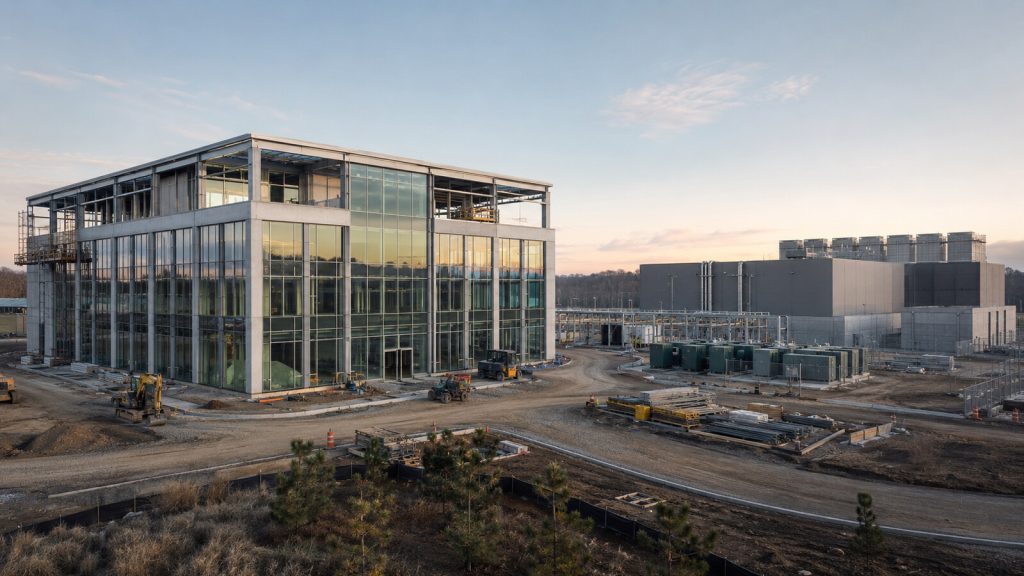
Office construction spending rose 15.1% from June 2025 to June 2026, but that increase does not establish a recovery in conventional office property. The Census Bureau’s private office category includes general offices, financial buildings, and data centers. Investors should separate those uses before drawing conclusions about tenant demand, leasing conditions, development capacity, or asset value.
The distinction matters because each property type depends on a different operating system. A traditional office requires employers willing to lease space at rents that support the basis and capital plan. A data center requires power, interconnection, cooling, fiber, specialized construction, and a credible user or operator. A single national spending figure cannot answer either investment question.
The practical conclusion is that office construction spending is a useful screening signal, not a property thesis. The number becomes actionable only after it is reconciled with asset type, location, physical progress, demand evidence, capital structure, and delivery risk.
What June 2026 Office Construction Spending Actually Shows
The Census Bureau’s August 3 construction report estimated private office construction at a seasonally adjusted annual rate of $115.8 billion in June 2026. That was 2.8% above the revised May rate and 15.1% above June 2025. By comparison, total private nonresidential construction was nearly unchanged for the month and 4.7% below its year-earlier rate.
Those figures measure the value of construction put in place during the period. They do not measure completed square footage, signed leases, occupancy, rent growth, property prices, or investment returns. The annual rate is also a seasonally adjusted expression of June’s pace, not $115.8 billion of spending completed during June.
The published June estimates are preliminary and subject to revision. The reported growth is meaningful, but investors should still compare several months and later releases before describing a durable trend.
Why the Office Category Can Mislead Real Estate Investors
The federal office category is broader than the property label used in many investment memoranda. The Census Bureau’s construction classifications place administration buildings, computer centers, professional buildings, data centers, and financial institutions within office construction. Data centers are specifically defined as buildings containing the hardware needed to store, process, and transmit digital information.
This classification means the 15.1% increase cannot be assigned to traditional tenant offices without more granular evidence. It also does not mean a data-center investment is automatically attractive. It means the aggregate series contains projects with materially different demand drivers, physical systems, capital needs, and operating risks.
The spending boundary matters too. Value put in place includes installed materials, labor, equipment rental, contractor profit, architectural and engineering work, project overhead, and certain interest and taxes during construction. It excludes land acquisition, ordinary maintenance and repairs, and special-purpose equipment such as data-center racks and servers.
An investor comparing a conventional office development with a data center therefore should not treat the Census number as a complete cost measure for either one. The reported construction shell and fixed systems may be only part of the capital required to create a usable, income-producing asset.
Four Filters for Reading Office Construction Spending
1. Identify the property use before interpreting demand
Asset use determines what the spending can plausibly signal. For a conventional office, relevant evidence includes net absorption, vacancy, sublease availability, tenant credit, lease term, concessions, renewal probability, location, amenities, and the cost of tenant improvements. National construction activity cannot establish those facts for a specific building.
Primior’s analysis of remote work and commercial real estate describes the continuing split between locations and building quality. That divergence is a reminder that even the traditional office segment cannot be underwritten as one uniform market.
For a data center, the demand case is different. Investors need evidence about available and deliverable power, utility timing, fiber routes, cooling design, water requirements where applicable, customer or operator commitments, redundancy, equipment responsibility, and the economic life of the facility. A favorable national category does not resolve site-specific capacity.
2. Separate nominal spending from physical supply
Higher construction spending can reflect more projects, greater physical progress, higher costs, a different mix of projects, or some combination. The value-put-in-place series is a dollar measure. It does not state how much rentable office area or powered data-center capacity was delivered.
This is important when costs are volatile or projects become more technically intensive. Two years with similar building area can produce different spending totals. Conversely, a large rise in spending does not necessarily create a proportional rise in available space or operating capacity.
Owners and capital partners comparing a development or repositioning plan can bring the asset, budget, demand evidence, and capital objective to Primior for a structured review before treating a national construction series as support for the project.
3. Match the spending period to the development timeline
Construction spending records work as it progresses, so current activity can reflect decisions made well before the latest release. The Census Bureau’s construction-duration methodology tracks value completed month by month from project start through completion. Large nonresidential projects can distribute spending across extended schedules.
Investors should map when land was controlled, approvals were obtained, major contracts were signed, work began, capital was committed, and delivery is expected. A strong current spending rate may describe projects already deep into construction rather than new decisions responding to today’s leasing or financing conditions.
The reverse can also occur. A viable project may not appear materially in current spending if power, entitlements, financing, design, or procurement remain unresolved. Pipeline announcements should be separated from construction underway, and construction underway should be separated from facilities ready to produce cash flow.
4. Test whether the capital plan reaches stabilization
Construction activity creates value only when the asset can be completed, operated, and financed on acceptable terms. The underwriting should include remaining cost, contingency, interest carry, reserves, schedule sensitivity, lease-up or commissioning, operating expenses, and the conditions for permanent financing or exit.
A conventional office may require tenant improvements, leasing commissions, concessions, amenity upgrades, and reserves after core construction is complete. A data center may require customer-specific fit-out, electrical equipment, commissioning, and technology investment that is outside the federal construction measure. Responsibility for each cost must be explicit.
Primior’s real estate development stage-gate framework provides a practical governance structure. Each release of capital should depend on updated evidence about basis, approvals, utilities, design, pricing, financing, schedule, demand, and downside capacity.
How the Signal Changes Traditional Office Underwriting
For traditional offices, rising category spending should not override building-level leasing evidence. An investor should compare the proposed project with competitive availability, tenant movement, effective rents after concessions, required improvement packages, operating costs, and the time needed to reach stabilized occupancy.
Quality and location can support demand while older or poorly positioned assets remain challenged. That creates a selective investment environment rather than a broad recovery. A favorable basis may still support repositioning when the building can serve a defined tenant need and the capital plan reflects realistic absorption. New supply at an unsupported basis can deepen risk even while aggregate spending rises.
The downside case should combine weaker leasing with higher improvement costs, delayed occupancy, and refinancing pressure. If value depends on rapid rent growth or a return to historical office utilization, the assumption should be identified as a scenario rather than treated as current evidence.
How the Signal Changes Data Center Underwriting
For data centers, construction growth confirms substantial physical investment but does not prove that every proposed campus has usable capacity or durable economics. Power availability, interconnection dates, generation strategy, zoning, community constraints, fiber, cooling, water, procurement, and customer concentration can determine whether a site operates as planned.
The Census boundary creates a second analytical issue. Racks and servers are excluded, so office construction spending does not represent the complete investment required to deliver computing capacity. Investors need to know which party owns the equipment, funds replacements, bears obsolescence risk, and controls the customer relationship.
Contract quality also matters. A long-term commitment may improve visibility, but its value depends on counterparty credit, pricing, escalation, renewal, termination rights, power-cost allocation, and the owner’s remaining obligations. Physical scarcity can support a site while a weak contract or overbuilt capital structure impairs the investment.
Use the Category as a Question, Not an Answer
June’s 15.1% rise in private office construction spending is a real and notable data point. Its correct interpretation is narrower than the headline suggests. The category mixes traditional offices, data centers, and financial buildings, while the measure captures work installed rather than leasing, operating performance, or total technology investment.
Disciplined investors should use the release to ask where capital is being deployed and which assets can convert construction into durable cash flow. They should then verify use, location, demand, remaining cost, utilities, contract quality, schedule, financing, and downside protection at the project level. Primior’s real estate investment framework applies the same principle: entry basis, execution control, cash-flow potential, and risk discipline matter more than a broad category label.
Investors, owners, and developers evaluating a conventional office, data-center site, or related capital plan can work with Primior to assess the asset-level economics and execution risks before committing capital.
This article is provided for general informational purposes only and does not constitute investment, legal, tax, accounting, engineering, or other professional advice, an offer to sell, or a solicitation of an offer to buy any security or investment product. Construction estimates are preliminary and subject to revision. Property performance varies, and all investments involve risk, including possible loss of principal.


