

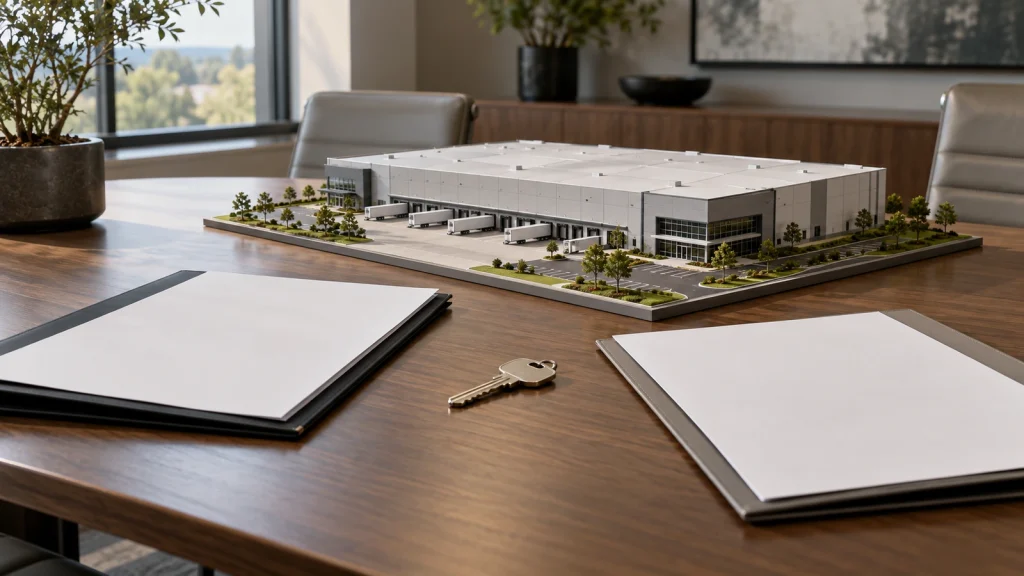
A sale leaseback transaction converts owned real estate into cash while allowing the seller to remain in the property as a tenant. It can improve liquidity and redeploy capital, but it also replaces ownership with a contractual rent obligation and transfers future residual value to the buyer. Both parties should underwrite the sale price, lease economics, operating credit, property condition, and exit rights as one transaction.
The central question is not whether the transaction raises cash. It is whether the net proceeds justify the long-term occupancy cost, reduced control, and risks assigned through the lease.
What Is a Sale Leaseback Transaction?
In a real estate sale leaseback, an owner-occupant sells a property and simultaneously leases some or all of it from the buyer. The seller becomes the tenant, and the buyer becomes the landlord. The business receives sale proceeds without immediately relocating, while the investor receives a leased property whose value depends on both the real estate and the tenant’s performance.
Public filings show that the structure is not standardized. A July 23, 2026 SEC-filed transaction disclosure contemplated a $37 million property sale and a 10-year triple-net lease of 100,519 square feet. A separate 2025 bank sale-leaseback filing reported a 15-year initial term, three five-year renewal options, and 2% annual rent escalations across 165 properties. These are transaction examples, not market terms for another property.
One Closing Creates Two Economic Positions
The seller receives liquidity but assumes rent
The gross sale price can overstate usable capital. Deduct mortgage payoff, prepayment costs, transaction expenses, taxes, required reserves, tenant improvements, and other closing uses. Then identify exactly how the remaining cash will be deployed. Paying down expensive debt, funding a high-confidence expansion, or stabilizing liquidity presents a different case from using proceeds to cover continuing operating losses.
The Office of the Comptroller of the Currency documented a credit appeal in which sale-leaseback proceeds improved liquidity and covered prior cash burn, but weak operating performance and unreliable projections still supported a substandard credit rating. The proceeds changed liquidity; they did not repair the operating business.
The buyer acquires real estate plus tenant exposure
The buyer is not purchasing a bond with a building attached. It is acquiring land and improvements subject to a lease, tenant credit, use restrictions, operating requirements, market rent, and residual-value risk. A high contractual rent can increase initial income while weakening tenant coverage and making the property harder to release if the tenant defaults.
Underwriting should therefore separate property value from lease value. Review replacement cost, comparable sales, market rent, alternative uses, zoning, physical condition, location, and expected residual demand. Then evaluate the tenant’s financial capacity and the enforceability and durability of the lease cash flow.
Seller-Lessee Underwriting: Five Decisions
1. Calculate net liquidity, not headline proceeds
Build a closing waterfall from gross price to cash available for the stated business purpose. Include debt release requirements, defeasance or prepayment amounts, transfer taxes, brokerage, legal and advisory fees, environmental or repair escrows, and tax reserves. Any proceeds committed to a lender-controlled account or immediate capital work are not unrestricted liquidity.
2. Measure rent against operating cash flow
Use a defined measure such as EBITDAR, fixed-charge coverage, or another operating cash-flow metric appropriate to the business. Reconcile it to audited or reviewed financial statements and test cyclicality, customer concentration, capital expenditure, taxes, debt service, and working-capital needs.
Coverage should be stressed before the transaction closes. Model lower revenue, margin compression, delayed collections, higher insurance or property taxes, and scheduled rent escalations. A business can receive substantial cash at closing and still become less resilient if fixed occupancy cost rises faster than operating cash flow.
3. Read the complete lease term
Initial term alone is insufficient. Review renewal options, termination rights, purchase options, rent resets, annual escalators, assignment and subletting, change-of-control provisions, casualty, condemnation, default remedies, guaranties, financial reporting, and cross-defaults. Primior’s weighted average lease term guide explains why options and contractual endpoints must be distinguished from the enforceable remaining term.
4. Allocate operating and capital obligations
Many sale-leasebacks use triple-net or absolute-net structures. The tenant may remain responsible for taxes, insurance, utilities, maintenance, repairs, and major replacements. Confirm the roof, structure, building systems, environmental obligations, code work, and casualty restoration rather than relying on the label “net lease.”
Primior’s property condition assessment framework provides a method for converting building findings into timing, responsibility, and funding decisions. Deferred maintenance does not disappear when the deed transfers if the lease returns the obligation to the seller-lessee.
5. Price the loss of control and residual value
Ownership permits a business to sell, refinance, redevelop, or stop using the property subject to its financing and legal constraints. After a sale leaseback, relocation, expansion, alterations, signage, subleasing, financing changes, and a later business sale may require landlord approval.
Owners evaluating a sale leaseback can work with Primior to connect property value, operating cash flow, capitalization, lease structure, and long-term execution alongside independent legal, tax, accounting, appraisal, lending, and other advisers.
Buyer-Lessor Underwriting: Real Estate and Credit Must Agree
Start with the tenant’s business model, management, historical financial statements, forecasts, debt, liquidity, ownership, industry risks, and location-level importance. Determine whether the lease is guaranteed by the operating company, a parent, a special-purpose entity, or no stronger party. A guaranty is only as useful as the guarantor’s capacity and enforceability.
Then test the property independently. Primior’s commercial real estate appraisal guide explains why income, cost, and comparable evidence may support different conclusions. If contractual rent exceeds market rent, capitalizing that rent without adjusting for tenant credit and re-leasing risk can overstate durable value.
Model default before the tenant’s financial position deteriorates. Estimate downtime, legal cost, carrying cost, tenant improvements, leasing commissions, renovation, market rent, and the property’s value vacant or subject to a replacement lease. Specialized headquarters, manufacturing facilities, cold storage, healthcare properties, and other operational assets may require substantial conversion capital.
A Sale Leaseback Transaction Scenario
Assume a business sells a distribution facility for $24 million and signs a 15-year triple-net lease. Initial annual base rent is $1.68 million, implying a 7% initial yield to the buyer:
$1.68 million annual rent divided by $24 million purchase price = 7%.
The seller uses $14 million to repay secured debt and reserves $1 million for transaction costs and potential taxes. Net deployable liquidity is $9 million:
$24 million proceeds – $14 million debt payoff – $1 million reserve = $9 million.
If normalized EBITDAR is $6 million, initial rent coverage is approximately 3.57 times. A 20% EBITDAR decline reduces that measure to approximately 2.86 times before considering other fixed charges:
$4.8 million stressed EBITDAR divided by $1.68 million rent = 2.86 times.
With 2% annual rent increases, total nominal base rent over 15 years is approximately $29.1 million. That total should not be compared directly with the $24 million sale price because the payments occur over time and the business retains occupancy. It does show why the transaction cannot be evaluated as $24 million of proceeds without a corresponding obligation.
For the buyer, the 7% initial yield is not a sufficient conclusion. The model must address rent coverage, escalation sustainability, guarantor strength, financing, property taxes, capital obligations, alternative use, and value after the lease expires. The figures are hypothetical and do not predict value or investment performance.
Accounting and Tax Form Do Not Automatically Follow the Documents
Under FASB Topic 842, the parties first determine whether a sale occurred under the transfer-of-control guidance. FASB educational materials state that a qualifying sale is followed by lease accounting, while a failed sale and leaseback is accounted for as a financing transaction. A finance leaseback can preclude sale accounting, and repurchase rights can affect the analysis.
Federal tax characterization also depends on substance. An IRS technical advice memorandum explains that true-sale treatment depends on whether the benefits and burdens of ownership passed to the buyer under all facts and circumstances. It discusses legal title, possession, property taxes, risk of loss, residual value, useful life, rent, and repurchase terms. The memorandum is fact-specific and cannot determine another taxpayer’s treatment.
If the property sale is respected, gain, depreciation recapture, basis, transaction costs, state taxes, and lease deductions still require separate analysis. Accounting sale treatment, federal tax treatment, lender treatment, and the negotiated legal form should be reconciled rather than assumed to be identical.
A Controlled Sale Leaseback Decision
A disciplined sale leaseback transaction values the property, tests the tenant, calculates net liquidity, measures rent coverage, allocates capital obligations, and models both default and residual value. The seller should know what the released capital will earn or protect. The buyer should know whether the property remains investable if the original tenant fails.
Business owners, investors, and capital partners can work with Primior to assess sale-leaseback economics, property evidence, capitalization, and execution risk with independent legal, tax, accounting, appraisal, lending, and technical professionals.
This article is provided for general informational purposes only and does not constitute investment, legal, tax, accounting, appraisal, lending, engineering, or financial advice, an offer to sell, or a solicitation of an offer to buy any security or investment product. Sale-leaseback structure, characterization, costs, rights, obligations, and outcomes depend on the property, operating business, lease, transaction documents, jurisdiction, accounting standards, tax law, and current professional evidence. All investments involve risk, including possible loss of principal.


